Table of Contents
ToggleDiscovering termites in your home is never welcome news. Before you panic or drop thousands on a professional treatment, many homeowners turn to over-the-counter solutions like Ortho Home Defense. It’s widely available at hardware stores, reasonably priced, and marketed as a barrier solution. But here’s the honest truth: whether it actually kills termites depends on how you use it, what species you’re dealing with, and how advanced your infestation has become. This guide breaks down what Ortho Home Defense can and can’t do, when to DIY and when to call a professional, and what other termite control options exist for your home.
Key Takeaways
- Ortho Home Defense can kill termites on contact but won’t eliminate established colonies or prevent subterranean termites from finding alternate underground routes into your home.
- The product contains bifenthrin and works best as a preventive perimeter barrier for homes without active infestations, not as a solution for structural termite damage.
- Proper application requires spraying a continuous 6-inch-above and 12-inch-below-grade band around the entire foundation, plus reapplication every 3–4 months for effectiveness.
- Call a professional pest control service if you notice active termite damage inside the home, multiple entry points, or recurring infestations that DIY treatments haven’t resolved.
- Professional treatments using baiting systems and soil injections are far more effective at eliminating termite colonies from within than surface-only spray barriers.
What Is Ortho Home Defense and How Does It Work
Ortho Home Defense is a perimeter spray designed to create a chemical barrier around your home’s foundation and crawl spaces. It comes in ready-to-spray bottles and is marketed as a general pest barrier for ants, spiders, roaches, and termites. The product works by forming a treated zone in soil that repels or kills insects that cross it.
The application process is straightforward: you spray it along the foundation, under eaves, around windows, and into soil cracks. Most homeowners can handle the application themselves without special equipment. The spray sets up a barrier that’s supposed to last several months, though effectiveness drops over time and after rain.
It’s important to understand what type of barrier you’re creating. Ortho Home Defense is a contact and residual insecticide, meaning it kills on contact and leaves a lasting residue. But, it’s not a bait system that worker termites carry back to the colony. That distinction matters because termites have different behaviors depending on species and colony size.
Does Ortho Home Defense Kill Termites
The short answer: it can, but with significant limitations. Ortho Home Defense may kill termites that contact the treated perimeter, but it won’t eliminate an established colony and won’t prevent subterranean termites from finding alternate routes into your home.
Subterranean termites, the most common type in North America, build mud tubes that bypass surface barriers. A spray-only approach often fails because these termites tunnel underground, bypassing the treated zone entirely. Drywood termites are slightly more vulnerable since they enter through wood directly, but even then, a surface spray won’t reach the colony inside walls or attic spaces.
Active Ingredients and Termite Effectiveness
Ortho Home Defense typically contains bifenthrin, a synthetic pyrethroid insecticide. Bifenthrin does have termiticide properties and is listed on product labels for termite control. But, its effectiveness depends entirely on direct contact and proper application.
The problem: termites don’t necessarily have to contact the treated zone if they’re already inside your home or can tunnel around it. Professional termite treatments use different chemistry (often fipronil or imidacloprid) delivered through baiting systems or soil injections that target the colony directly. These methods are far more effective at eliminating the source, not just the entry point.
Best Practices for Using Ortho Home Defense on Termites
If you decide to apply Ortho Home Defense, do it right or don’t do it at all. Half-measures waste money and give false confidence.
Preparation and Safety
First, wear nitrile gloves, safety goggles, and a dust mask or respirator rated for pesticide application. Bifenthrin is low toxicity to mammals but still a chemical, respect it. Clear the application area of toys, pets, and food sources. Ventilate crawl spaces and attics well before and after spraying.
Application Steps
- Inspect thoroughly before spraying. Look for mud tubes, termite damage (hollow-sounding wood, sagging floors), and entry points. If you find active damage, note it, a barrier spray alone won’t fix it.
- Prepare soil by removing debris, leaf litter, and mulch around the foundation. Termites hide in undisturbed areas: clearing gives better coverage.
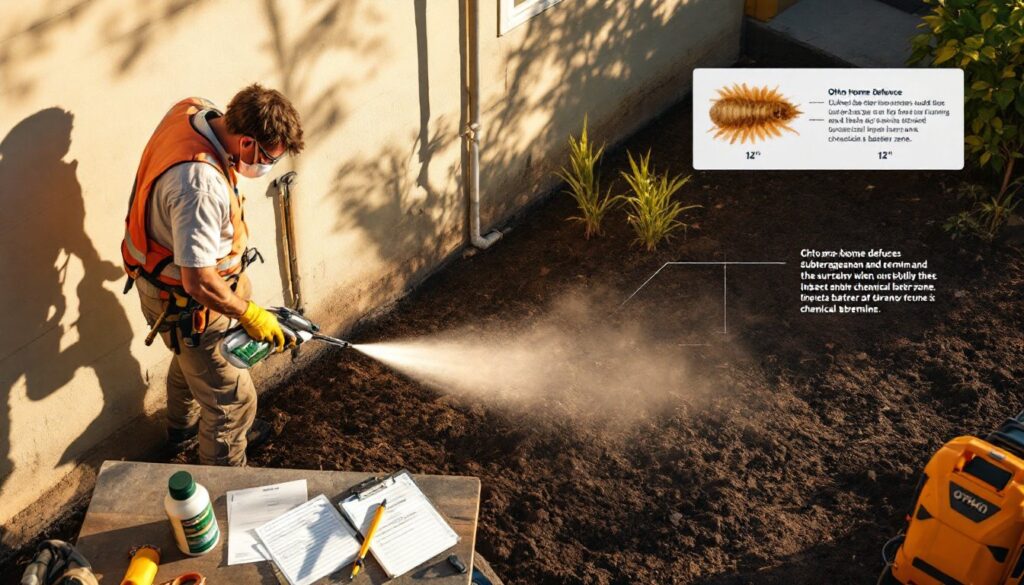
- Apply a continuous band 6 inches above and 12 inches below grade around the entire foundation perimeter. Don’t skip corners or gaps, that’s where termites enter.
- Spray into cracks and crevices where foundation meets siding, around piers, and under deck connections.
- Re-apply every 3–4 months or after heavy rain. A one-time application is insufficient against active infestations.
Realistic Expectations
Ortho Home Defense is best suited to prevention or light pest pressure, not active termite infestations. If you’ve already found evidence of colonies inside your home, this product won’t solve it. You’re looking at spot treatments on the perimeter while a deeper problem goes unchecked.
When to Call a Professional Pest Control Service
Stop DIIYing and call a licensed pest control professional if any of these apply:
Signs You Need a Pro
- Active termite damage visible inside the home (tunnels in attic beams, sagging joists, hollow-sounding wood)
- Large infestation (multiple mud tubes, visible swarmers, widespread entry points)
- You’ve found termites but aren’t sure of the species (carpenter ants vs. termites require different treatments)
- Recurring infestations even though previous treatments
- Structural concern (settlement cracks, wood damage that may affect load-bearing elements)
Professional treatments involve soil injections, baiting stations, or liquid barriers applied with specialized equipment. A licensed pest control operator has access to industrial-strength termiticides and the knowledge to place them correctly. They also carry insurance and can spot structural damage you might miss.
Costs vary regionally, but expect $300–$1,000 for an initial treatment on a house-sized perimeter, with annual monitoring plans adding $150–$400. Angi and local references can help you find vetted providers and get realistic cost estimates for your area.
Alternative Termite Control Solutions for Your Home
Beyond Ortho Home Defense, several other options exist at different price points and effectiveness levels.
Over-the-Counter Alternatives
Boric acid powder is old-school and less reliable but cheap. It kills termites on contact but doesn’t create lasting soil barriers like bifenthrin does. Diatomaceous earth (food-grade, not pool-grade) works similarly and is less toxic, but again, it’s a contact killer and requires reapplication.
Research from pest control experts shows that professional-grade baiting systems outperform DIY sprays significantly. Bait stations use chitin-inhibitor compounds that interfere with termite molting, a mechanism that works across the colony, not just at the entry point.
Professional Treatment Options
- Liquid barriers (injected into soil or applied as a trench) create a continuous, unbroken treated zone. Far more effective than surface sprays.
- Baiting stations placed around the perimeter allow termites to carry poison back to the colony, eliminating it from the inside out.
- Spot treatments with foam injected directly into wall voids or attics for drywood termites.
Prevention Measures
Regardless of treatment, reduce termite risk by:
- Keeping mulch and wood debris at least 12 inches from the foundation.
- Maintaining proper drainage (standing water attracts termites).
- Sealing cracks in foundation and siding.
- Fixing water leaks (termites need moisture).
- Removing dead trees and stumps near the house.
Home improvement experts and general home guides consistently recommend a layered approach: barrier treatment, baiting, and exclusion work together better than any single method.
Conclusion
Ortho Home Defense can kill termites on contact and serves as a reasonable preventive perimeter barrier for homes without active infestations. But, it’s not a silver bullet for established colonies or a substitute for professional treatment when termite damage is already present. Use it for what it is: a maintenance tool, not a cure. If you’re uncertain about infestation severity or have seen structural damage, hire a professional. The $300–$500 investment now beats the $5,000+ repair bill later.